
Introduction to Coconut
The coconut palm is endearingly called ‘kalpavriksha’ meaning the tree of heaven.
The coconut palm is the most useful palm in the world. Every part of the tree is useful to human life for some purpose or the other. The copra obtained by drying the kernel of coconut is the richest source of vegetable oil containing 65 to 70 per cent of oil. Contemporary studies have shown increasing benefits of coconut oil right from improving brain function and moisturising skin to aiding weight loss management.
Grown in over 80 countries worldwide, the coconut palm excels in the tropics, notably The Philippines and Indonesia closely followed by India and Brazil which combined, account for approximately 80% of the world’s coconut production.
The coconut is of significant economic importance to these top producers.
There are many uses of this exotic fruit tree.
Attempting to list every single use would be impossible however listed below are a few uses of the amazing and functional coconut.
Pistachios are grown for its edible nuts and pistachio tree is a small to medium sized tree with a branching main stem and a spreading growth habit. It can reach up to 20 feet height in wild conditions and up to 10 feet in cultivated conditions. Pistachio is one of the culinary nuts grown in most of the countries and belongs to the cashew family. These nuts are the lowest calorie of the nuts, but they are rich in phytosterols, antioxidants, unsaturated fat, carotenoids, vitamins and minerals and fiber. It is believed to have originated from Middle East and Central Asia. Pistachios belong to the family of “Anacardiaceae and genus of “Pistacia”. Basically pistachio trees are either male or female. However, both are required to produce a crop. Usually the nuts are produced on the female trees where as male trees provide the pollen to fertilize the female tree flowers. Pistachio trees take longer time to get into production stage.Anywhere between 6-12 years. Pistachio nuts have excellent demand both locally and internationally. If they are grown in right climate by following good pistachio farming practices, pistachio cultivation can become a lucrative business.
Uses of The Coconut Tree
- The Roots are used to make dyes, used as a toothbrush, mouthwash, and has medicinal value.
- Coconut Leaves are used in The Maldives as a roofing material for houses, and are used to wrap rice, for cooking, and for storage in The Philippines.
- They have been used to make toys in India, and they are used to make brooms and burnt to ash to make lime.
- Toothpicks and satay skewers are made out of the ribs on the leaves.
- Coconut Tree Trunk is used as timber to make houses and boats, in bridge building, furniture, drums, and canoes.
Different Uses of Coconut
- Coconuts are a serious superfood with its long list of health benefits, medicinal uses, and nutritional value.
- No part goes to the waste as every layer has or had a use somewhere in the world, making it worthy of the title the tree of life.
- The Coir – this is the fiber on the outside of the husk and is used in ropes, doormats, potting compost, mattress stuffing, brushes, mats, rugs, joint sealer for boats (caulking), and sacks.
- In Brazil, a tea is made from the husk fibers which is said to benefit inflammatory disorders.
- The Coconut Husk & Shell – the outer part of the coconut, these have been used for buffing floors, fuel, for charcoal, as handicrafts, as buttons, as drinking vessels, sponges, musical instruments, theatrical sound effects, burnt to ward off mosquitoes and when ground down, the husk is used in cosmetics as a skin exfoliant.
- The Coconut Husk & Shell – the outer part of the coconut, these have been used for buffing floors, fuel, for charcoal, as handicrafts, as buttons, as drinking vessels, sponges, musical instruments, theatrical sound effects, burnt to ward off mosquitoes and when ground down, the husk is used in cosmetics as a skin exfoliant.
- The coconut shells are also used as bird feeders, a haven for small birds and rodents and even are a feature in the fairground as a coconut shy.
Topical Uses of Coconut Oil
With medicinal, nutritional and topical uses and benefits, there are in excess of 100 reasons to have coconut oil in some form in the home. Here is a selection of them. Here we go!
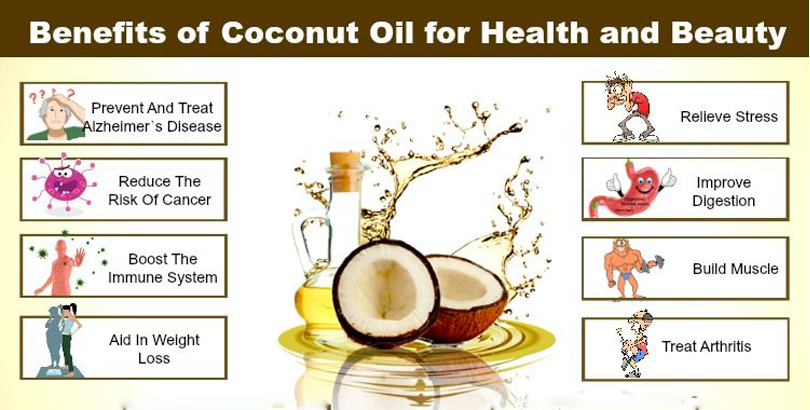
- Natural skin softener and moisturizer.
- Reduces fine lines, puffiness and dark circles under the eyes
- Prevents skin infections.
- Anti-Wrinkle.
- Soothes Sunburn and treats blisters and burns.
- Removes makeup.
- Improves skin tone, elasticity, and age spots.
- Heals itchy skin and stops burning from insect bites including snake bites.
- Lessens varicose vein occurrences.
- Conditions the hair, prevents split-ends and treats dry flaky scalp including dandruff.
- Removes head lice.
- Conditions the hair, prevents split-ends and treats dry flaky scalp including dandruff.
- Heals nail fungal conditions.
Medicinal Uses of Coconut Oil
- Eases acid reflux and gives relief in gallbladder disease.
- Stabilizes blood sugar levels and insulin production
- Kills viruses such as flu and infectious diseases.
- AProtects against cancers in the colon, breasts, and digestive tract.
- Soothes Sunburn and treats blisters and burns.
- Protects against intestinal disorders
- Strengthens the liver.
- Reduces pain and inflammatory conditions such as arthritis.
- Relieves symptoms of Chronic Fatigue Syndrome.
- Soothes earaches when combined with olive oil and garlic.
- Protects against Alzheimer’s disease.
- Improves calcium and magnesium absorption, promoting strong bones.
- Helps stabilize female hormones and prevents hot flushes and vaginal dryness during menopause.
The Meat
- Eases acid reflux and gives relief in gallbladder disease.
- Rich in vitamins A and B group (particularly B5), phosphorus, iron, magnesium, zinc and potassium.
- High in Fat and Carbohydrates.
- Widely used fresh or dried in thousands of culinary dishes. Deserts and confectionery are particularly favorable with the coconuts sweet taste.
- Coconut oil is extracted from the dried Copra.
- Copra cake or copra meal is made as livestock feed.
Coconut Milk
- The milk of the coconut is extracted from the flesh or meat of the fruit has high saturated fat content. It is used in a variety of ways from seafood dishes in Brazil to being used in baking instead of animal fat.
- Whilst there are two types of milk (thick and thin milk) available, most countries who import coconut milk get it in a can and remain unaware of the two different types.
- Used to make a home brew in Rendell Island (Solomon Islands) where it is fermented with sugar and yeast and left for a week.
- The famous Pina Colada cocktail traditionally contains coconut milk.
- Coconut milk is said to promote plant growth.
The coconut palm
Coconut palm, (Cocos nucifera), treeof the palm family (Arecaceae). It is one of the most important crops of the tropics. The slender, leaning, ringed trunk of the tree rises to a height of up to 25 metres (80 feet) from a swollen base and is surmounted by a graceful crown of giant featherlike leaves. Mature fruits, ovoid or ellipsoid in shape, 300–450 mm (12–18 inches) in length, and 150–200 mm in diameter, have a thick fibrous husk surrounding the familiar single-seeded nut of commerce. A hard shell encloses the insignificant embryo with its abundant endosperm, composed of both meat and liquid.
Coconut fruits float readily and have been dispersed widely by ocean currents and by humans throughout the tropics; they probably originated somewhere in Indo-Malaya. Marco Polo was among the first Europeans to describe coconuts.
Coconut palms flourish best close to the sea on low-lying areas a few feet above high water where there is circulating groundwater and an ample rainfall. Most of the world’s coconuts are produced on small native plantations. Propagation is by unhusked ripe nuts. These are laid on their sides close together in nursery beds and almost covered with soil. After 4 to 10 months the seedlings are transplanted to the field, where they are spaced at distances of 8–10 metres. Palms usually start bearing after 5 to 6 years. Full bearing is obtained in 15 years. Fruits require a year to ripen; the annual yield per tree may reach 100, but 50 is considered good. Yields continue profitably until trees are about 50 years old.
Pistachio seedlings (rootstock) are raised in nurseries. They are then propogated by budding. In the fall season, budding is carried out and the budded trees are planted. Planting depends on the size of the seedling. If it is mature it may be planted the same year or else next year.
Sales of Coconut Products go Through the Roof
Coconut has held the interest of science for generations, but recently coconut has been termed as a super food and this has led to the coconut craze reaching new heights, with health food retailers struggling to meet demands, as consumers spend up big for coconut-derived waters, flours and dairy replacement products.Organic stores are unable to import enough coconut flour to keep up with customer demand.There’s also a growing demand for drinking coconut water and coconut milk-based beverages, yoghurts and ice cream. Coconut oil – used for nutritional and beauty reasons – sells for up to $32.95 per liter online, while coconut flour costs $15-20 per kg.
Royal farmsteads is just rightly placed to make the most from this growing interest in coconut.
On an average, coconut yields 44 nuts/palm/year. However, under scientific cultivation West Coast Tall gives 80 nuts/palm/year in coastal Kerala and Karnataka. The hybrids yield 100-140 nuts/palm/year. On 1 hectare you can use precision farming and plant 1,000 trees.An average well maintained plantation can get 100-400 coconuts per year. Royal farmsteads has kept it's average at a humble 120 nuts per year X 1,000 trees, that comes to 120,000 nuts per year.
Soil Requirements for the coconut palm
Coconut can be grown on wide variety of soils. However, red sandy loam, alluvial, laterite and coastal sandy well-drained soils rich in organic matter and with a pH ranging from 5.0 to 8.0 are best for its growth and higher yield.
Coconut Plantation Site Selection
Like all other trees, site selection plays a major role in producing coconuts. Soil with a minimum depth of 1.2 to 1.5 meter and good water holding capacity should be selected for coconut cultivation. Soils with underlying hard rock or soils with water logging and poor drainage are not suitable for coconut cultivation. Similarly clayey soils should be avoided.
Coconut Plantation Land Preparation and Spacing
In coconut plantation like in any farming, size of the pit depends on the soil type and water table of the soil. In loamy soils, pits with size of 1 x 1 x 1 meter should be dug and filled with top soil to the height of 40 to 50 cm. In laterite soils, large pits are recommended and pits size of 1.2 x 1.2 x 1.2 meter should be dug and filled with loose soil, well rotten farm yard manure like cow dung and ash up to a depth of 55 to 60 cm before planting. For moisture conservation, 2 layers of coconut husk should be placed at the bottom of the pit with concave surface facing upwards while filling the pits. For prevention of termite attack, BHC 10 % DP should be sprinkled on the coconut husk. In-order to soften the hard pan of the soil, common salt of 2 kg per pit should be applied at least 6 months before the plantation.
Generally, a square system of planting is preferred with a spacing of 7.5 x 7.5 meter which will accommodate 178 coconut-palms per 1 hectare. However, a spacing of 7.0 to 10 meter is practiced in many coconut growing regions of the country.
Use of quality seedlings is very important for better yield. Farmers should select vigorous coconut seedlings of 1 year old and having minimum of 10 cm at the collar level to plant in the farm land. Early splitting of leaves in the seedlings could be a factor of selecting good seedlings. In case of water logged areas, 18 months to 24 months old seedlings are preferred. The best planting season in coconut farming is the pre-monsoon time frame from May to June.
Coconut Propagation
Propagation is done through seeds. Seedlings can be raised on nursery beds and transplanted in the main field.
Coconut Plantation Manures and Fertilizers
From the first year of plantation, regular manuring and use of chemical fertilizers should be carried out for proper vegetative growth, early flowering and fruit bearing. The first application of in-organic fertilizers should be carried after 3 months of coconut plantation. In case of lateritic and acidic soils, Rock phosphate is recommended as source of phosphorus. Usually fertilizers should be applied in 2 split doses during May to June and Sep to Oct months for rainfed trees. In case of irrigated palms, 4 or more equal split doses should be carried to avoid heavy rainfall period. In case of sandy soil with acidic nature,along with regular fertilizer, 1 kg of dolomite should be supplemented during April to May in the plant basins and should be forced into the soil.
Coconut Plantation Irrigation
Coconut palms require 200 to 250 liters of water once in 4 days under basin irrigation conditions where as in summer, 40 to 45 liters of water/palm/week will increase the yield. In case of water problem, one should go for drip irrigation. The quantity of water recommended for drip irrigation is 66 % of the open pan evaporation. However, the soil type and climatic conditions greatly influence the irrigation of palms.
Intercultural Operations in Coconut Plantations
As part of inter-cultural operations, ploughing, digging and forming small mounds during the months of Aug-Sept and spreading them in the months of Dec to Jan should be carried out. Other beneficial operations are, making shallow basins with a radius of 2 meter before the onset of monsoon and filling them at the close of monsoon. In order to control the weeds, regular inter-cultural operations are advised. To retain the moisture, control the weed growth and protect the soil from erosion, mulching must be done at tree basins dry hay.
Inter-cropping Coconut Plantations
The inter-space in the coconut palm orchard can be utilised by cultivating crops like banana, ground nut (peanut),elephant foot yam, pineapple, sweet potato, chillies or any other vegetable and legume crops during initial 6 to 8 years period. In older plantation of coconut, cinnamon, cocoa, pepper and clove can be cultivated as mixed crops along with inter-crops. Mixed farming by growing fodder grasses such as guinea grass or hybrid napier is also a good idea as it supports the animal feed requirements.
Pruning Coconut Plantations
Pruning activities like removing dried leaves or dead leaves or diseased leaves should be carried out regularly. Regular cleaning of the palm basins will check the growth of weeds.
The following are the main pests and diseases found in coconut plantations.
Major insect-pests found in coconut plantations are: Mealy bugs and Scale insects, Termites, White grub, Eriophid Mite of Coconut, Slug Caterpillar, Rhinoceros Beetle, Red Palm Weevil, Black headed caterpillar, Coreid bug and Rats.
Major diseases found in coconut farming are: Bud rot, Leaf rot, Stem Bleeding, Root (wilt) disease, Tanjavur wilt, Mahali, Crown chocking, Leaf blight or Grey Leaf Spot, Tatipaka Disease.
Harvesting Coconut Plantations
Coconut palms are normally ready for harvesting in about 1 year after the opening of the spathe. Coconuts are harvested at different intervals based on the need. Usually coconuts are harvested at tender stage for coconut water purpose. The frequency of harvesting also depends on the yield of the palms. In well maintained orchards, coconut bunches are produced regularly and harvesting can be done once in a month. Coconut palms can yield fruit up to 60 to 65 years.
To know more about how Royal farmsteads can assist you with the development and management of your own coconut plantation, and to receive a free initial consultation, please call us today on