
Introduction to Pistachio
The highly flavourful pistachio nuts are actually seeds produced by the pistachio tree. The pistachio, a member of the cashew family, is a small tree originating from Central Asia and the Middle East.
The pistachio tree produces seeds that are widely consumed as food. Pistacia vera often is confused with other species in the genus Pistacia that are also known as pistachio. These other species can be distinguished by their geographic distributions (in the wild) and their seeds which are much smaller and have a soft shell.
Pistachio is a desert plant, and is highly tolerant of saline soil. It has been reported to grow well when irrigated with water having 3,000–4,000 ppm of soluble salts. Pistachio trees are fairly hardy in the right conditions, and can survive temperatures ranging between −10 °C (14 °F) in winter and 48 °C (118 °F) in summer. They need a sunny position and well-drained soil. Pistachio trees do poorly in conditions of high humidity, and are susceptible to root rot in winter if they get too much water and the soil is not sufficiently free-draining. Long, hot summers are required for proper ripening of the fruit. They have been known to thrive in warm, moist environment.
Pistachio is a desert plant, and is highly tolerant of saline soil. It grows well when irrigated with water having 3,000–4,000 ppm of soluble salts. Pistachio trees are fairly hardy in the right conditions, and can survive temperatures ranging between −10 °C (14 °F) in winter and 48 °C (118 °F) in summer. They need a sunny position and well-drained soil. Pistachio trees do poorly in conditions of high humidity, and are susceptible to root rot in winter if they get too much water and the soil is not sufficiently free-draining. Long, hot summers are required for proper ripening of the fruit. They have been known to thrive in warm, moist environments.
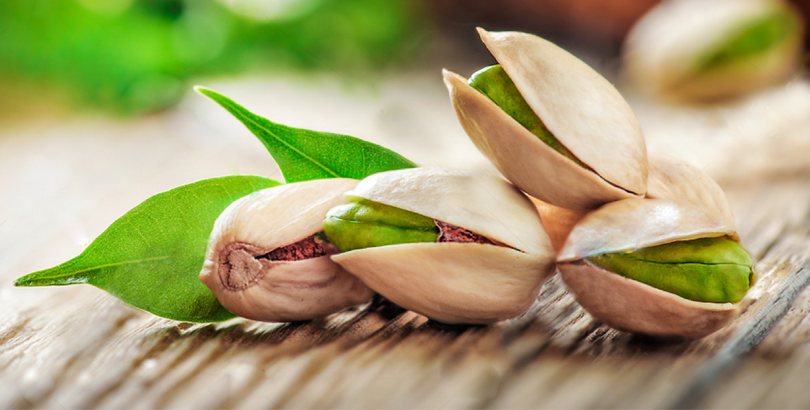
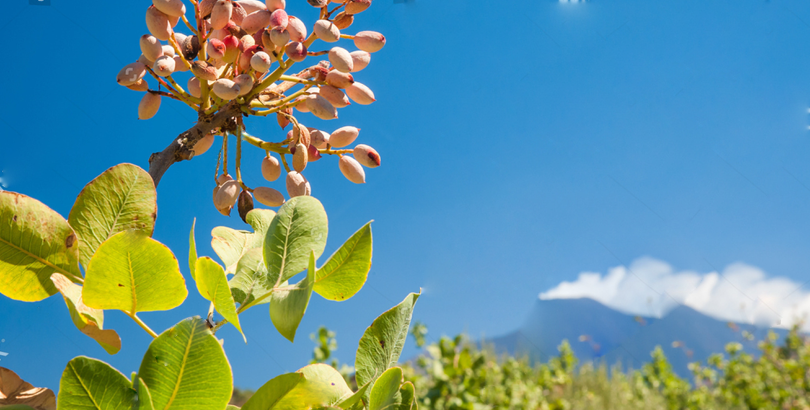
The pistachio bush grows up to 10 m (33 ft) tall. It has deciduous pinnate leaves 10–20 centimeters (4–8 inches) long. The pistachio plants are dioecious, with separate male and female trees. The flowers are apetalous and unisexual, and borne in panicles. The fruit is a drupe, containing an elongated seed, which is the edible portion. The seed, commonly thought of as a nut, is a culinary nut, not a botanical nut. The fruit has a hard, creamish exterior shell. The seed has a mauve skin and light green flesh, with a distinctive flavor. When the fruit ripens, the shell changes from green to an autumnal yellow/red, and abruptly splits part way open. This is known as dehiscence, and happens with an audible pop.
Each pistachio tree averages around 50 kilograms (110 lb) of seeds, or around 50,000, every two years. The shell of the pistachio is naturally a beige color, but it is sometimes dyed red or green in commercial pistachios. Originally, dye was applied by importers to hide stains on the shells caused when the seeds were picked by hand. Most pistachios are now picked by machine and the shells remain unstained, making dyeing unnecessary except to meet ingrained consumer expectations. Roasted pistachio seeds can be artificially turned red if they are marinated prior to roasting in a salt and strawberry marinade, or salt and citrus salts. Like other members of the Anacardiaceae family (which includes poison ivy, sumac, mango, and cashew), pistachios contain urushiol, an irritant that can cause allergic reactions.
Pistachio Cultivation
Pistachios are grown for its edible nuts and pistachio tree is a small to medium sized tree with a branching main stem and a spreading growth habit. It can reach up to 20 feet height in wild conditions and up to 10 feet in cultivated conditions. Pistachio is one of the culinary nuts grown in most of the countries and belongs to the cashew family. These nuts are the lowest calorie of the nuts, but they are rich in phytosterols, antioxidants, unsaturated fat, carotenoids, vitamins and minerals and fiber. It is believed to have originated from Middle East and Central Asia. Pistachios belong to the family of “Anacardiaceae and genus of “Pistacia”. Basically pistachio trees are either male or female. However, both are required to produce a crop. Usually the nuts are produced on the female trees where as male trees provide the pollen to fertilize the female tree flowers. Pistachio trees take longer time to get into production stage.Anywhere between 6-12 years. Pistachio nuts have excellent demand both locally and internationally. If they are grown in right climate by following good pistachio farming practices, pistachio cultivation can become a lucrative business.
Uses
- The various health benefits of pistachios include lowering of LDL (bad) cholesterol level in the blood.
- They help in iron absorption in the body.
- They are known to protect the body from Diabetes Mellitus 2
- Pistachios are proven to have antioxidant and aphrodisiac properties.
- Being a good source of dietary fibre, pistachios help in digestion of food.
- Pistachios help in adding glow to the skin by reducing skin dryness.
- They are believed to reduce the risk of eyesight deterioration.
- Being low calorie nuts, pistachios are widely used by individuals looking for weight loss
- They are an excellent source of vitamins and minerals
- Pistachios do not clog the arteries and are therefore known as heart friendly nuts.
The pistachio crop requires specific weather conditions. The trees prefer above 36°C day temperature and winter temperature of 7°C for a long season. The trees don't grow well at higher altitudes because of the constant cool temperature. Jammu and Kashmir in India is a natural habitat for the growing of Pistachio trees.
Pistachio trees can be cultivated in many different types of soils. But well drained deep sandy loam soils aid their development best. They do not grow well in places of high humidity but are quite drought tolerant. If pistachio production is planned on a large scale, it is advisable to do a soil test. Though the trees are hardy and can tolerate higher alkalinity to a certain extent, if the soil pH is kept between the range of 7.0 to 7.8 the tree will produce quality nuts with high yields.
The process of land cultivation for the pistachio crop is similar to other nut crops. The soil is chiselled, ploughed and disked, then brought to a fine tilth stage. Hardpan found uptil 7-8 feet of soil is broken as pistachio trees are deep rooted and water stagnation affects them adversely.
Pistachio seedlings (rootstock) are raised in nurseries. They are then propogated by budding. In the fall season, budding is carried out and the budded trees are planted. Planting depends on the size of the seedling. If it is mature it may be planted the same year or else next year.
While planting the seedlings holes must be dug large enough to accommodate the roots. They are generally planted 1" lower than they were raised in the nurseries.
When it comes to plant spacing, it depends on irrigation.
For bearing Pistachio nuts, both male and female trees should De planted in the ratio of 1:8 (one male and eight female trees) to 1:10 (one male and ten female trees).
They should be maintained with enough moisture whenever needed, though Pistachio tress are drought tolerant,Mulching is the best practice to retain the water.
Drip irrigation can be adopted for proper utilization of water. Avoid any water logging conditions. The trees don’t need any irrigation in rainy season.
Pistachios trees have a similar nitrogen requirement just like other nut trees. However, fertilizers should not be applied in the first year of planting but in the subsequent year. Each pistachio tree should be provided with 450 grams of ammonium sulphate in 2 split doses during the growing season. In later years, actual nitrogen (N) of 45 kg to 65 kg per acre should be provided.
Pistachio trees should be developed into a modified open-vase shape.They should be therefore trained to grow upward and outward direction. The center of the tree should be kept open to admit sunlight for better flower formation and fruit set, which might be needed by the 4th or 5th winter season. Secondary branches should be removed as part of thinning operation. Once the tree framework has been established, only minor pruning cuts are needed. Weed control is another task in pistachio production for healthy growing of trees and producing quality nuts. Make sure to clean the space between trees as the weeds compete for nutrients. Herbicide treatments should be mainly used for the berms and are applied before or after appearance of nuts. To control weeds as well as retains the water content in the soil, mulching must be carried out.
Like all other nuts, pistachios are prone to attacks by pests.Mites, Stinkbug and Leaf-footed plant bug are the common insect pests found in Pistachio production. Powdery mildew, Rust, Alternaria late blight, Armillaria root rot, Crown gall, Pistachio dieback, Septoria leaf spot, Panicle and shoot blight, Pistachio psyllid and
Pistachio twig borer are some of the diseases found in pistachio cultivation. Contact your local horticulture for control solutions
Pistachio trees take around 12 years to produce nuts. The budded trees become ready to produce fruits for 5 years and but do not reach maximum production until the 12th year of planting. ( Pistachio trees begin bearing the 5th year after budding. However, a significant crop is not harvested until the seventh or eighth season. The first full production year starts occurring around 12th year only). The easy identification of maturity is when the hull separates easily from the shell. Generally, this period extends for 6 to 10 days. Care should be taken while harvesting to avoid underdeveloped kernels.
Yield of the Pistachio nuts mainly depends on climate , cultivar (variety) and crop management practices. On an average a yield of 8 to 10 kg per fully matured tree can be obtained after 10-12 years of budding